How AI Changed the Way I Think and Work as a Developer

I still vividly remember the feeling of going through documentation page by page, typing every line of code by hand, and writing every function myself. Then, when the code finally ran and the product started to take shape, I felt an indescribable sense of excitement. A few years ago, I experienced another kind of excitement when I typed a comment describing the function I needed and saw AI suggest almost exactly the code I was about to write. And now, all it takes is a "prompt" for AI to run and build an entire system for you. It may not be perfect, but that feeling makes me both excited and a little overwhelmed. I am excited because I can now easily turn any idea into reality and build whatever I want. But then: What am I going to do?
As a developer working primarily with PHP/Laravel on the backend and VueJS on the frontend, I have become accustomed to writing every piece of logic myself, debugging, and doing my own research. But as AI has continued to evolve and gradually become part of my workflow, I have realized that it is not only changing how I work, but also how I think about the work of a developer.
From "Writing Code" to "Guiding Solutions"
In the past, when I received a task, I often spent quite a lot of time on the "boilerplate" stage: creating Migrations, Models, Controllers, and Request validation in Laravel, or setting up the structure of a Component and defining props/emits in Vue. These tasks were repetitive and not difficult, but they took time.
Now, I describe the business requirements and the desired data structure clearly, and AI helps me quickly build that foundation — from an Eloquent Model with all the necessary relationships to a Vue Composable that handles reusable logic. What I find interesting is that my work has shifted from "writing every line of code" to "describing the problem correctly and reviewing the solution." I need to understand the problem more clearly before coding, because if the prompt is vague, the result returned by AI will be just as vague.
One important change in mindset is that I no longer consider "writing code quickly" to be a measure of my ability. The difficult part now lies in reading, understanding, evaluating, and refactoring what is generated, making sure it follows Laravel conventions, matches the project's patterns, and does not break the existing architecture.
This approach has already worked at a much larger scale, such as the case of Bun:
Jarred Sumner, the creator of Bun (a JS runtime), used Claude Code to rewrite the entire Bun codebase (~535,000 lines) from Zig to Rust in 11 days — something that was estimated to require around 3 full-time engineers working for a year if done manually. What is noteworthy is not that "AI wrote the code," but rather how he designed an entire workflow in which multiple AIs took on the roles of writer, reviewer, and bug fixer, running in parallel and continuously iterating. You can read more about it in this article: Rewriting Bun in Rust.
On a much smaller scale, I realize that I am also doing a miniature version of this: instead of typing everything myself, I clearly describe the requirements, let AI propose a solution, and then take on the role of the "reviewer" myself before merging.
From "Searching and Reading Dozens of Pages" to "Asking and Validating"
In the past, whenever I encountered a strange error or needed to learn about a new package, I would open around 5–6 tabs: Stack Overflow, GitHub Issues, official documentation, someone's personal blog, and so on. Then I would have to synthesize the information myself. Sometimes, this took quite a lot of time as I had to dig through dozens of web pages containing tens of thousands of lines of tedious technical information just to find what I needed.
Now, I usually start by asking AI to give me a quick overview — for example, comparing Laravel Queue with Laravel Horizon, or understanding how a Vue library handles reactivity under the hood. The great thing is that AI helps me narrow down the scope of my search very quickly. But one rule I always stick to: never trust it 100%. I use AI's suggestions as a starting point for deeper, more focused research through official documentation or practical verification. In other words, AI has transformed me from someone who "searches for information" into someone who "evaluates information" — a skill that may seem small, but is actually much more important.
This is not just my personal observation; it is part of a world trend. If you are a developer, the name Stack Overflow is probably very familiar to you. Looking at the current state of Stack Overflow provides one of the clearest examples of this shift in behavior. According to some statistics, the number of new questions posted on Stack Overflow has dropped significantly since ChatGPT was launched in November 2022, and by mid-2025, it had fallen to levels similar to when the site first launched in 2009.
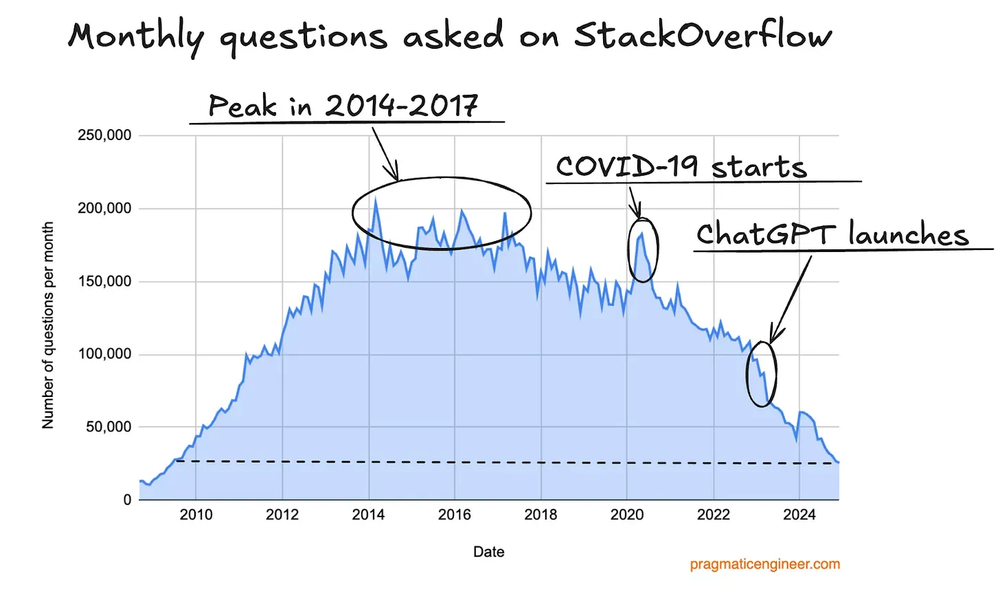
Source: Stack overflow is almost dead
The Biggest Change: The Mindset of a Developer
If I had to choose the single biggest change, I would say that my role has shifted from "coder" to "decision-maker and quality controller."
- I spend more time thinking about business documentation, architecture, edge cases, and maintainability rather than simply focusing on making the code work.
- I have learned to ask better questions because the quality of AI's answers depends heavily on the quality of the questions I ask.
- I am more careful when reviewing code because I know that AI-generated code may not always be correct.
The Limitations I Always Remind Myself About
AI can feel like magic, but it is not perfect, and I try not to let it replace my own critical thinking:
- Do not blindly copy and paste, especially when dealing with important business logic such as payments, authorization, or sensitive data.
- Do not skip understanding the fundamentals: if you only use AI as a "code generation machine" without understanding why it wrote something the way it did, your fundamental skills may deteriorate over time.
- Real-world experience is still necessary: AI is good at common patterns, but when it comes to the specific business requirements of a project, human experience and the ability to understand the context are still irreplaceable.
AI "Does Everything," But That Doesn't Mean You Are Allowed to Become Lazy
This is probably the reminder I have given myself the most for more than a year now. The easiest trap to fall into when using AI is not "using it incorrectly," but using it correctly for so long that you forget why you need to understand things yourself. When a Controller, a test suite, or a complex refactoring task can all be completed within minutes, it is very easy to feel that "everything is fine" and skip the most important step: asking yourself whether you actually understand it.
Here are a few principles I try to follow to avoid falling into that "lazy" state:
- Keep learning: new AI capabilities, the business domain, and the fundamentals. I deliberately use some of the time I save on typing code to read and learn instead. Sometimes it is a new feature of the AI tool I am using; other times, it is a deeper look into the customer's business domain.
- Do not let manual debugging skills deteriorate: I still deliberately read stack traces, set breakpoints, and reason through problems myself alongside asking AI, especially when dealing with unusual errors.
- Read code, not just output: I try to spend time reading my colleagues' code and the source code of the packages we use, not because AI cannot explain them, but because reading the actual code helps me maintain a feel for a real codebase — something an AI-generated summary cannot replace.
Looking Ahead: How Do We Avoid Becoming "Extinct"?
AI technology changes every day, and models are becoming increasingly intelligent. To avoid falling behind, you should keep improving yourself every day. If you have some free time, you might consider doing some of the things I am currently doing.
- Follow trends, but do not chase every new tool. I do not need to try every new AI tool that is released, but I try to read enough to understand the broader trends, such as how tools are moving from "autocomplete" to "agents" that can execute multiple steps and verify their own results. Joining AI communities on Facebook is one of the ways I keep up with AI developments every day.
- Invest in the skill of "orchestrating AI" rather than just the skill of writing prompts. The Bun case study I mentioned above clearly demonstrates this: the greatest value does not come from having one AI that is good at writing code, but from designing a workflow in which multiple AIs can collaborate and cross-check one another. On a much smaller scale, I believe the ability to break a problem down, know when to let AI work autonomously, and know when to intervene yourself will become increasingly important compared to simply knowing how to write a good prompt.
- Invest in the things AI finds hardest to replace: domain knowledge and system architecture. AI is good at common patterns, but deep knowledge of a project's specific business domain and an understanding of why an architectural decision was made many years ago are things that only humans accumulate over time. This may be the most sustainable knowledge a developer can have during this period.
- Maintain critical thinking and do not lose the ability to evaluate what is right and wrong. Falling behind does not only mean "not knowing how to use the latest tools." It can also mean "trusting AI without verification" to the point where you can no longer recognize when it is wrong.
- Share and learn with your team. I have found that discussing with the team how each person is using AI, which prompts are effective, and which tools are suitable for different tasks helps the whole team learn much faster than having everyone figure things out individually.
I do not think there is a guaranteed formula for "never falling behind" during this period. But I believe that the people who fall behind are not necessarily those who are slow to learn the latest tools, but those who stop questioning how they work.
I Can Do It, So Can You
Looking back, AI has not turned me into a "completely different" developer. Instead, it has helped me become a better version of myself. I code faster, write more comprehensive tests, and learn faster, but in return, I also have to think more deeply, ask better questions, and take more responsibility for what AI suggests.
Perhaps that is the most interesting thing about this period: AI is not taking away the work of developers; it is redefining what it means to be a good developer. I believe I can master AI, and so can you!!!
Sources: